

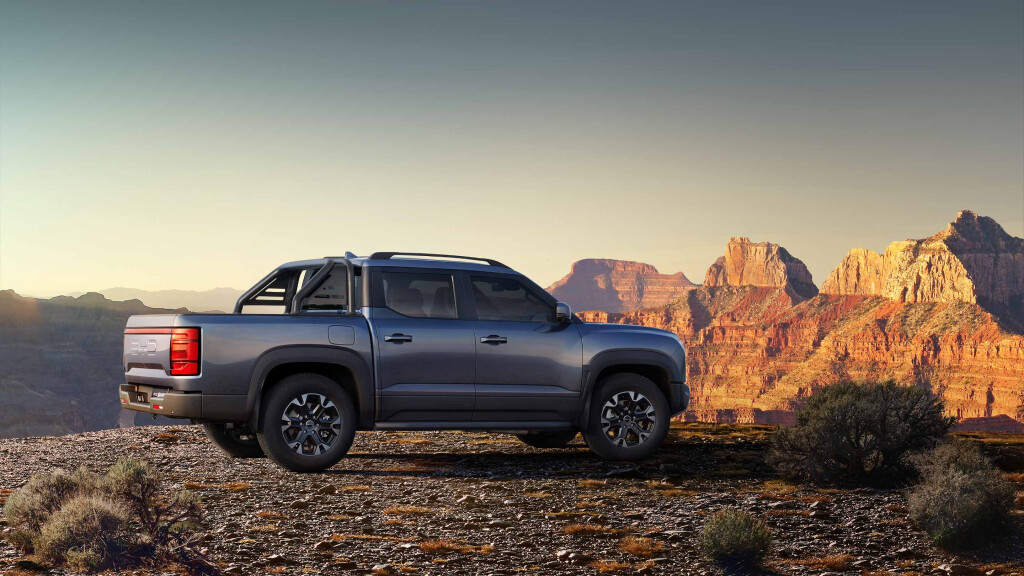
I’m ignoring the temptation to make a cheesy Jaws reference — but automakers from Ford to Toyota surely must hear that nerve-jangling “da-dump” movie soundtrack playing in the background as they read the dispatches from Mexico on the new BYD Shark.
Was there ever a vehicle so appropriately named?
No, this Chinese-designed and -built mid-size hybrid pickup is not likely to devour the Ranger and the Tacoma. Not yet.
But keep an eye on Shenzhen-based BYD, whose ambitions for years have included a potential invasion of the North American market.
While BYD executives continue to pooh-pooh any such notion, the company is actively shopping for an assembly site in Mexico — a potential bridge to the US that might enable BYD to duck Joe Biden’s new 100% tariff on Chinese vehicle imports.
Pickup trucks are a relatively new addition to BYD’s rapidly expanding portfolio, which now roughly spans the $10,000-$225,000 price spectrum. The dual-cab Shark will start at just over $50,000, depending on market, trim level and equipment, which isn’t bad for a twin-motor gasoline-electric hybrid that spits out 400+ horsepower and is reputed to hit 60 mph in under 6 seconds.
The compact Ford Maverick hybrid is just a little smaller than the Shark, but way cheaper, with a base sticker below $30,000. That may be small consolation to Ford. How long do you suppose it will take BYD to come up with a $30,000 Sharklet? Or, for that matter, for Chinese rival Great Wall to start sending some of its mid-size pickups to the States, tariff or no?
Detroit executives, whose bread is still buttered with pickup-driven profits, needn’t be so nervous just yet. Until they take a closer look at the Shark — and picture it with a Blue Oval in the grille in place of those three bold Chinese initials.
A little too close for comfort, no?

 felixstrategy.com
Leave a reply to Alysha Webb Cancel reply