
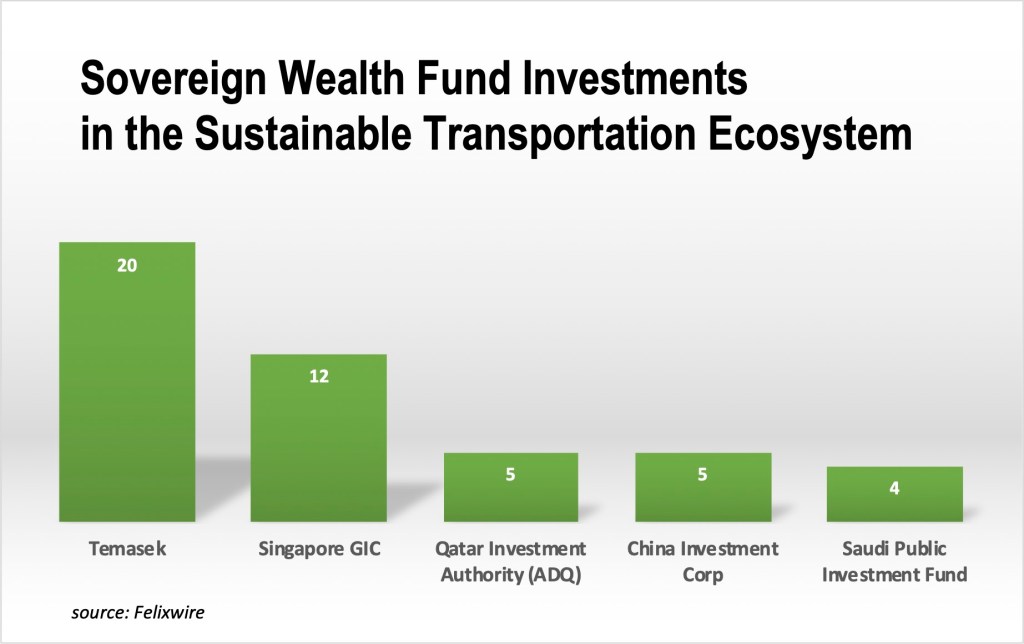
My Felixwire database sheds some light on investments in the sustainable transportation ecosystem by some of the world’s largest sovereign wealth funds. There are a few surprises.
China Investment Corp is the world’s largest sovereign fund, with $1.35 trillion in assets under management, according to the Sovereign Wealth Fund Institute (SWFI). But it has just a handful of investments in sustainable mobility, including a stake in Talison Lithium, an Australian-based mining firm controlled by China’s Tianqi Lithium, and one in Eovolt, a French maker of folding electric bikes.
In the Middle East, the Saudi Public Investment Fund (PIF) has $777 billion in assets under management, according to SWFI, but its sustainable mobility investments have been largely limited to two American electric vehicle manufacturers — Tesla and Lucid — and the Saudi EV startup Ceer, a joint venture with Taiwan’s Hon Hai Precision, parent of Foxconn. A hint that PIF is hedging its bets: Investments in McLaren, Aston Martin and Pagani, three European makers of supercars with powerful internal combustion engines.
The Qatar Investment Authority (ADQ), which has $475 billion in assets under management, has a slightly greener focus when it comes to transportation, with investments in Chinese EV maker Xpeng, battery makers QuantumScape and SK On, and recycler Ascend Elements.
The most active sovereign funds in the sustainable mobility space? Singapore’s Temasek and GIC, with 20 and 12 investments in the sector, respectively.
Temasek, which has $450 billion in assets under management, has invested in more than 1,000 companies over the past 50 years, according to investor website PitchBook. Notable holdings in the sustainable transportation ecosystem: Ola Electric, Our Next Energy, Einride, Zipline, SES and Gogoro.
GIC is even larger, with $770 billion in assets under management and more than 1,300 investments since 1981, according to PitchBook. Notably, it has funded Northvolt, ChargePoint, Lime and Zum.
 felixstrategy.com
Leave a comment